Thursday, May 8, 2008

West Point


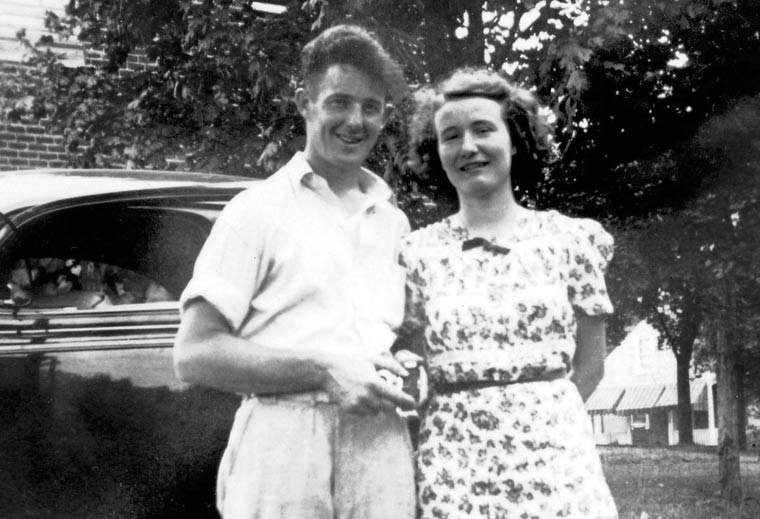
Nellie Melton, George Marion at the end of Woolen Mills Road, this area referred to as "under the hill" by residents of the Woolen Mills Village

The United States government was a large purchaser from 1884 on. Large amounts went to disabled soldiers' homes. From 1899 until at least the middle 1930's, the cadets of West Point were clothed in Charlottesville fabrics. Beginning in the late eighties, the mill succeeded in surplanting foreign mills as the manufacturer of fine doeskins used in the pants and trimmings for the highest ranking army officers. This was accomplished only after six months of experimentation and was quite impressive since no American mill was able to make such fabrics. Thereafter, on several occasions, other mills underbid the Charlottesville company and won this contract, but in every case the contractor gave up his efforts and bought the material from Marchant's firm.

Wednesday, May 7, 2008

uniforms for the letter carriers


Marion House

Beginning in 1887, the mill won in competition with all the mills in the country a large contract to supply 1000 uniforms for the letter carriers of Philadelphia. Two years later, a postoffice circular calling for bids on these uniforms set as the standard cloth certain meltons and doeskins made by the Charlottesville Woolen Mills. This specification was not, of course, designed to give the company a monopoly of that contract but such was the result since no other mill could reproduce the high quality of the cloth.--Harry Poindexter

Tuesday, May 6, 2008

gold medals for uniform cloth


Drayman's House, VADHR 002-1260-0080

The problems of the Charlottesville Woolen Mills, then, were twofold: to gain a reputation for high quality; to create a market.
The mill quickly earned a national acclaim for the quality of its cloth. Fine kerseys, Venetian overcoatings, doeskins, and meltons of dark-blue, sky-blue, and cadet-gray were the chief products of its looms. Military uniforms were its speciality. Before the fire, the mill produced a limited quantity of these fabrics, but afterward they were improved greatly in quality and reputation. Furthermore, the company designed original fabrics and created a market for then. Perhaps it means little to find a local paper extolling them "as among the finest made in this country," having "few peers and no superiors." But the truth of these statements is proved by other sources. At the Chicago and St. Louis Expositions the mill won the only gold medals awarded for uniform cloths. The Chicago Fair Commissioners in 1892 chose a Charlottesville fabric for the standard to be used in uniforming the 1500 guards at the Exposition.--Harry Poindexter

Monday, May 5, 2008

uniform cloth


Damage to Harlow's wall is done by vehicles large and small

In the years between the War of Secession and the first World War, Americans voiced a preference for light weight clothing more in line with new modes of heating, transportation, and styles. It was this change which sealed the fate of primitive rural mills.

In plotting their course after 1882, the directors of the Charlottesville mill determined to continue making heavy fabrics, but production was shifted from cloth for men's suitings to material for uniforms of various types. Whether this decision was farsighted or whether later events made it seem so, cannot be known. However, its effect was obvious. Uniform styles changed slowly and once a market was established a mill of that type could estimate its output much more shrewdly than one making apparel fabrics. Since close similarity in subsequent orders of uniform cloth was of prime importance to an institution, competition was lessened once a mill had won a contract. furthermore, foreign cloths were practically excluded because of the requirements of uniformity.--Harry Poindexter

Sunday, May 4, 2008

cause for survival


Union Chapel Sunday School minutes

The Charlottesville Woolen Mills not only escaped the fate of many of its Southern counterparts but managed to avoid the extremes of prosperity and depression which frequently rocked the industry in the North. Before 1882 the company had developed in a pattern typical of the American wool manufacture, but after that date its history bore little relation to the apparel-producing mills which dominated the industry. Foreign competition, changes in styles, and the appearance of worsteds did not create the disturbances that worried many manufacturers. Only in one respect did the mill follow a major pattern after 1882. That was in its almost complete specialization of product. It was this event which moved the company to a lightly populated fringe of the industry and made it relatively immune from the diseases afflicting woolen mills after 1893. Perhaps, too, it was the major cause for its survival in an unfavorable location. --Harry Poindexter

Saturday, May 3, 2008

Rubber v stone


Damaged resource. Cel Harlow's stone wall shows damage secondary to commercial traffic short cutting through this residential neighborhood.

It will be noted that the Central Atlantic region held its own. New England's increasing percentage came from two factors: the rise of new mills there and the decline of the small inefficient western and southern mills whose income was mainly based on custom carding and local sales. By 1914 the South possessed only sixty of the 1000-odd mills in the nation; Massachusetts alone had nearly one hundred. In 1919 New England mills employed sixty percent of all woolen workers.--Harry Poindexter

Thursday, May 1, 2008

Woolen Mills Village


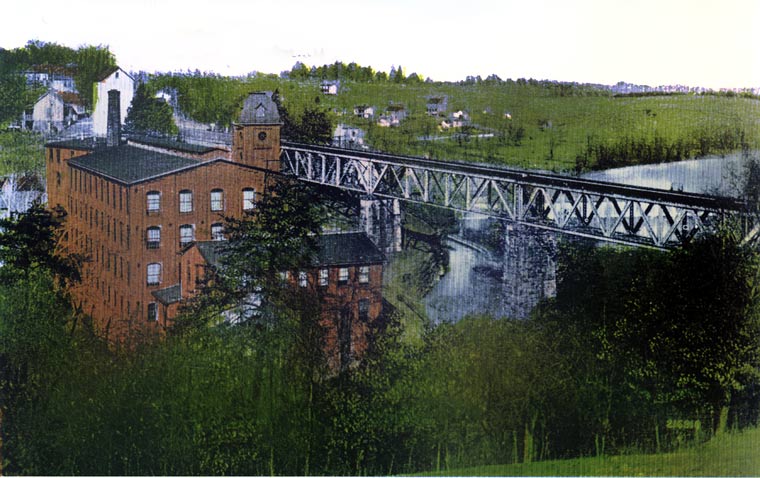
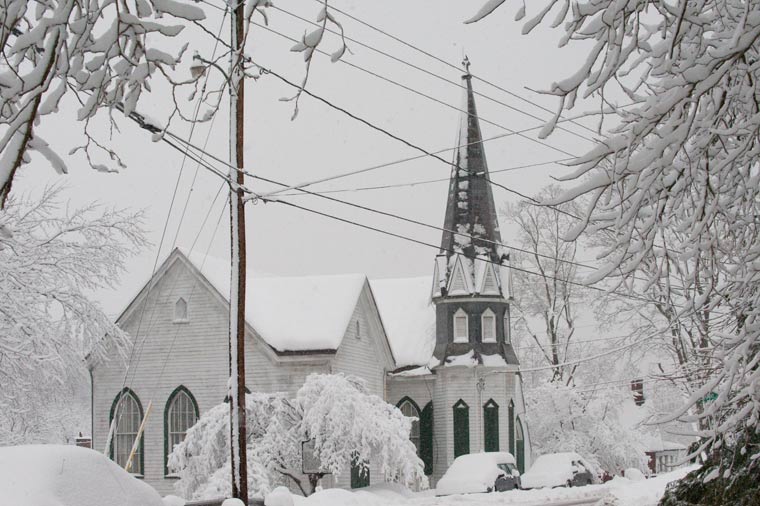
Union Chapel and millhouses foreground, Mill and Monticello, background

Shrinking profit margins put a premium on plant location. With raw material and product markets primarily oriented at Boston, the industry shoved a strong tendency to concentrate in New England. The following table showing the changing distribution of the woolen industry by sections is significant:

--Harry Poindexter